Have you ever ended a week and looked back and thought, “What just happened??” This was one of those weeks, and as I begin to reflect on everything that happened, I see that the Lord was present with me and some dear friends. Yesterday, I started a new series on the book of Matthew. My method from the pulpit is to go verse by verse and chapter by chapter. What better way to get the context of a verse than to study the entire chapter and book? As I mentioned in my last post, culture can add so much to the Bible when we understand it, and that still applies to chapter one of the book of Matthew. In church on Sunday, we were talking about Jesus’ family tree in the children’s sermon. I had a big, long history of the Bible, and we laid it out. The next thing I knew, the kids were crawling all over it, inspecting the paper. 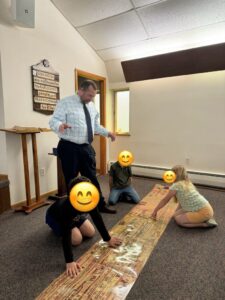 This history of the Bible begins all the way with Adam, and it brings us to modern-day history in a way. However, it is fascinating to look at the people of the Bible and to understand at what times they lived. When I read the Bible, I always understand it in a very linear fashion. My brain, for some reason, will assume that when Adam dies, Seth’s timeline begins, even though, according to the Bible, there is a 670-year gap between Seth being born and Adam’s death. Genesis 5:3-5 says, “When Adam had lived 130 years, he had a son in his own likeness, in his own image; and he named him Seth. After Seth was born, Adam lived 800 years and had other sons and daughters. Altogether, Adam lived a total of 930 years, and then he died.” Matthew begins his gospel by talking about the lineage of Jesus, beginning from the line of Abraham. And he continues all the way until David, and he says there are 14 generations between Abraham and David. Then he gives another 14 generations until the deportation to Babylon, and finally, he gives another 14 generations until Jesus is born. Matthew gives the line of Jesus through his father Joseph, well, his adoptive father. However, this in and of itself would not qualify Jesus to sit on the throne of David. It would make him an heir to the throne of David because he is adopted by Joseph and therefore is entitled to the rights of it, but there is something that stands in his way. Jeconiah. Jeremiah 22:30 says, “Thus says the Lord: ‘Write this man down as childless, a man who shall not succeed in his days, for none of his offspring shall succeed in sitting on the throne of David and ruling again in Judah.” So, shouldn’t this disqualify Jesus as being able to sit on the throne of David as the Messiah? By no means. You see, his mother Mary was also from the line of David, as we see in the gospel of Luke, so Jesus is still able to sit on the throne.
Once Matthew gets done with the genealogy, he goes into the birth of Jesus, and he doesn’t go into any detail, really at all, except to say that Mary and Joseph were betrothed to be married. We are probably familiar with the story, but I want to spend a little time on it before I get to my main point in this post. Mary and Joseph were betrothed to be married, and to us, we look at this as just an engagement. However, in their culture, this was a legally binding agreement to be married. After the prearranged marriage had been reached, Joseph would have left to go and prepare their home for them before the marriage. Mary would have no idea of when Joseph would return since they didn’t have a method of communicating as we do. So she would have to be waiting, ready. We see this throughout the scriptures. Matthew 25:1-13, Revelation 19:7, and John 14:1-4 allude to the Jewish wedding in one way or another. There was also a waiting period to make sure the bride was a virgin and not with child, and lo and behold, Mary is found to be with child. Joseph is set to divorce her quietly, but after a visit with an angel, he takes her as his wife. All of this just to say what?
God’s word will always be fulfilled. As we look at the scriptures, we should be confident in them. We are sitting in uncertain times, but we as believers need to keep running the race that is set before us. If the words that were spoken by God have been fulfilled in the birth of a Messiah about 2000 years ago, then we have no choice but to believe the words spoken by God about the upcoming times. Jesus tells us there will be wars and rumors of wars, earthquakes and famines, but this is only the beginning. (Matthew 24:6-8) Not more than 3 weeks ago, we had a man who was claiming to be the legitimate pope and the successor to Christ. Again, Jesus said there would be many false christs and prophets that would come in his name, but they are not to be believed (Mark 13:22). I am writing you to tell you to continue to be the salt of the Earth. Fight the good fight and push back against the enemy. His words are as true today as they were back in the time of Adam. Last week I had asked you a question that would cause you to do some studying, and I have another one for you. If Jesus is the lion of the tribe of Judah, where do we see that prophecy/blessing come from? Try not to Google it to get the answer, and let me know in the comments. Happy studying, and as always, I will be praying for you all!